

“Web3” is changing the digital landscape. In this latest iteration of the internet, users have more control of, and do more with, their data and assets than ever before, through their wallets. Self-custodianship and interaction with everything from your identity to your funds, art, and even in-game items is made possible partly through Web3 wallets.
What is Web3?
Web1 gave us the early, read-only internet, a place where most people could browse but not everyone could publish. Web2 opened the door to creating and sharing content, but did so through large centralized platforms that held most of the control.
Web3 takes us a step forward - moving users away from centralized platforms, and gives people true ownership of their personal information and digital assets. It opens the door to decentralized environments where anyone can participate. Instead of handing everything to a platform, Web3 allows you to decide what’s yours and how you want to use it.
It’s a big shift, but it doesn’t have to feel complicated. With the right tools, the right guidance, Web3 becomes a place where everyone can explore, learn and take part with confidence.
In the internet’s third generation, users (not platforms) are at the heart of the web experience.
Web3 is characterized by:
- Decentralized services: True data ownership, since users don’t have to trade their data for the ability to use platforms
- Decentralized governance: Trustless and permissionless environments
- Self-custody and use of public-key cryptography for secure user authentication
- Blockchain and smart contract technology
Web3 encompasses things like:
- Cryptocurrencies (which are just the tip of the iceberg but a common way beginners find their way into the Web3 space)
- Decentralized identifiers (DIDs)
- Decentralized autonomous organizations (DAOs)
- Applications (DApps)
- Finance (DeFi) tools
- and much more - all of which is accessible and interactable through Web3 wallets.
Why Web3 exists (the problem it tries to solve)
The shift toward Web3 isn’t happening by accident. It’s a response to some real limitations in today’s internet. This is especially true when it comes to things like how data is stored, who controls it, and how users connect across platforms. Web3 introduces new ways to manage identity, ownership, and access by putting users (not companies) at the center of the experience.
Here’s a simple breakdown of the challenges Web3 aims to improve.
Decentralization
In Web2, most of the internet runs on centralized platforms. A small number of companies store your data, manage your identity, and decide how you interact with their services. You can use the platform, but you don’t control what happens behind the scenes.
Web3 offers an alternative:
Instead of relying on a single company to validate actions or store information, Web3 distributes this responsibility across a network of participants. This creates systems that are more transparent, more resilient, and less dependent on any one provider.
Put simply:
Centralized platforms own the systems. Web3 lets you own your keys, data, and interactions.
Identity ownership
Today, your online identity is scattered across countless accounts, from email logins to social profiles, app accounts, and everything in between. Each service controls its own version of “you,” and if you lose access or a company shuts down, your identity goes with it.
Web3 offers an alternative:
Your identity can be tied to a single wallet address or decentralized identifier (DID), which you control. This lets you prove ownership, sign into applications, or verify actions without handing your information to a central authority.
Put simply:
You decide which parts of your identity to share - and when.
Interoperability gaps
In Web2, most platforms operate in closed environments. Your assets, progress, or data rarely move with you. For example:
- Items bought in one game stay locked in that game
- Subscription and account data can’t easily transfer
- Creator content depends on the rules of each platform
Web3 enables applications to talk to one another.
Blockchains and smart contracts create shared standards that make it possible for digital items, identities, and interactions to move between apps.
This opens the door to:
- Wallet-based login across services
- Digital assets that work in multiple environments
- Communities and creators owning their connections directly
It’s the difference between dozens of disconnected platforms and one open ecosystem.
Key takeaways as an intro to Web3
- Web3 represents the next evolution of the internet, shifting from centralized platforms to user-controlled systems built on blockchain technology.
- Web3 exists to address limitations of today’s internet, particularly around how data is stored, who controls it, and how users move between platforms.
- Web3 is powered by decentralized services, trustless governance, public-key cryptography, and smart contracts.
- Through a Web3 wallet, users can interact with DApps, digital identities, NFTs, DeFi tools, DAOs, and other decentralized environments.
How the web evolved (Web1 > Web2 > Web3)
The internet has developed in clear stages, and each of these phases introduced new ways to access information, create content, and interact online. Understanding how the web evolved helps explain why Web3 works the way it does today.
Web1 – read
Web1 was the first phase of the internet. It was mostly made up of static pages that users could read but not interact with. Information flowed one way: from the publisher to the reader.
In practice, this meant:
- Basic websites with no logins or profiles
- Limited interactivity
- A small number of people creating content
Web2 – read/write
Web2 introduced user participation. Social platforms, online marketplaces, and mobile apps made it easy for anyone to publish content, comment, and connect.
But these experiences came with a trade-off: platforms stored the data and controlled the rules.
This era is defined by:
- User-generated content
- Social networks and mobile apps
- Centralized storage of user data and identity
Web3 – read/write/verify
Web3 adds a crucial new layer: verification. Users can prove ownership of their data, identity, or assets through cryptographic keys — without relying on a central authority.
This shifts control back to the individual.
Key characteristics include:
- Wallet-based identity and authentication
- Decentralized infrastructure
- User-controlled data and assets
- Verifiable interactions across open networks
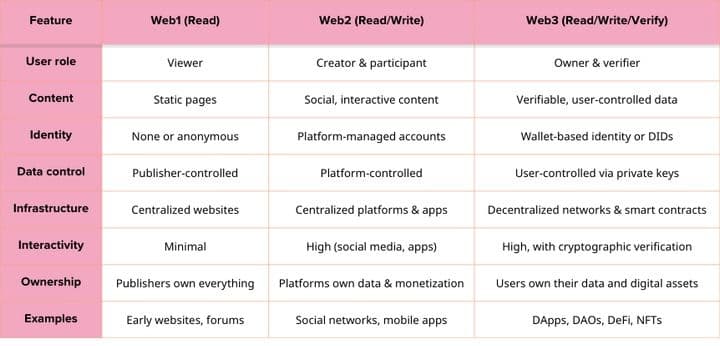
The building blocks of Web3
Web3 is powered by a set of core technologies that work together to enable decentralization, verifiable interactions, and user-controlled identity. Understanding these components makes it easier to see how Web3 wallets fit into the wider ecosystem.
Core technologies powering Web3
A blockchain is a shared digital ledger that stores data across many computers rather than in one central place. Each time new information is added, it’s grouped into a “block” and linked to the previous one, creating a chain that’s designed to be transparent and tamper-resistant.
In simple terms:
A blockchain records information in a way that many participants can verify, making it harder for a single party to alter or control it.
Private/public keys
Web3 uses cryptographic keys to manage identity and access.
- A public key (or wallet address) is like your username. You can share it with others so they can interact with you on-chain.
- A private key is like the master password that proves you control the wallet. Anyone with this key can access the wallet, which is why it must be kept secure and never shared.
In simple terms:
Your public key is how people find you while your private key is how you prove something belongs to you.
Smart contracts are pieces of code stored on a blockchain that automatically run when preset conditions are met.
They don’t rely on a central authority - the blockchain itself enforces the rules.
In simple terms:
A smart contract is like a digital “if this happens, then do that” rule that the blockchain follows automatically.
Consensus mechanisms (POW vs POS explained simply)
A consensus mechanism is how a blockchain agrees on what’s true.
Proof of Work (PoW)
Participants called “miners” solve complex puzzles to validate transactions. This is secure but requires significant energy.
Proof of Stake (PoS)
Participants “stake” cryptocurrency to help validate transactions. It uses far less energy and is designed for faster, more scalable networks.
In simple terms:
Different blockchains use different methods to agree on which transactions are valid.
Tokens (fungible, non-fungible, utility, governance)
Tokens are digital representations of value or rights on a blockchain.
- Fungible tokens: Each unit is identical (e.g., cryptocurrencies).
- Non-fungible tokens (NFTs): Each item is unique, often used for digital collectibles or access passes.
- Utility tokens: Provide access to a specific function or service.
- Governance tokens: Allow holders to vote on decisions within a project or protocol.
In simple terms:
Tokens represent things you can use, access, or prove ownership of on a blockchain.
Oracles (simple explanation)
Blockchains can’t access external information on their own.
Oracles are trusted data feeds that bring outside information (such as prices, weather, or events) into a blockchain so smart contracts can use it.
In simple terms:
Oracles connect blockchains to real-world data.
What you can actually do in Web3
Here are some of the most common things people use Web3 for today, all without needing to rely on traditional accounts or centralized platforms.
Sending/receiving digital assets
A Web3 wallet lets you send and receive digital assets recorded on a blockchain.
This could include cryptocurrencies, collectibles, or other on-chain items.
Your wallet address works like a destination or contact point, making peer-to-peer transfers simple.
Accessing DApps
Decentralized applications (DApps) execute core logic and store state on blockchain networks, enabling trustless interactions without intermediaries.
With your Web3 wallet, you can connect to DApps directly, whether you're exploring tools, communities, marketplaces, or other on-chain experiences.
Signing messages
Signing a message with your wallet lets you prove that you control a specific wallet address.
This is used for things like logging into services, confirming an action, or verifying that a request came from you - all without sharing personal information or passwords.
Connecting to decentralized identity systems
Some Web3 services use decentralized identifiers (DIDs) to manage identity.
Your wallet can act as your digital identity, giving you a way to verify yourself while staying in control of what you share.
Using blockchain-based gaming
Many Web3 games use blockchain technology to store in-game items, progress, or identities.
Your wallet lets you interact with these features, bringing your items or profile with you - even across different games that support the same standards.
Verifying digital proofs
On-chain proofs allow you to confirm things like ownership, participation, or eligibility without revealing extra information.
Your wallet can help verify these proofs securely, making it easy to interact with services that require confirmation.
Joining DAOs
Decentralized Autonomous Organizations (DAOs) use on-chain voting and coordination.
With your wallet, you can participate in governance decisions, contribute to community projects, or access DAO-managed spaces, depending on the rules of that specific community.
NFT-based access passes
Some experiences use NFTs as access passes for events, online communities, memberships, or content.
Your Web3 wallet lets you hold and present these passes whenever you need to verify access.
Benefits of Web3
Web3 introduces new ways for people to manage their identity, data, and interactions online. While the ecosystem is still developing, several meaningful benefits already stand out.
More control over digital identity
In Web2, your identity is tied to accounts that platforms create and manage.
In Web3, your identity can be tied to your wallet or decentralized identifiers (DIDs), giving you more control over how you log in, what you share, and where your data lives.
What this means for beginners:
You don’t need multiple usernames or passwords, and you choose which services can access your information.
Transparent systems
Public blockchains allow anyone to see how a system works, from how transactions are processed to how rules are applied. This transparency helps users understand what’s happening behind the scenes without relying on a single company to provide information.
What this means for beginners:
You can explore on-chain activity through public tools, making the process more open than traditional systems.
Permissionless participation
Many Web3 systems are open to anyone with a wallet. No application process, no gatekeeping, and no need for a platform to approve access.
What this means for beginners:
A more inclusive environment where people can explore tools, join communities, and interact with services at their own pace.
Community governance
Some Web3 projects let users take part in decision-making through on-chain voting or community proposals. This creates shared responsibility over how a system grows or operates.
What this means for beginners:
Communities agreeing on new features, updates, or rules - all visible and open to participants.
Challenges and limitations of Web3
Web3 introduces new possibilities, but it also comes with limitations that users should understand as the ecosystem continues to evolve.
- Scalability: Many blockchains process transactions more slowly than traditional systems, especially during busy periods.
- Usability: Interfaces and workflows can feel unfamiliar, and many tools are not yet designed for everyday users.
- Security risks: Smart contract bugs, phishing attempts, and malicious websites can lead to loss of access or funds if users are not cautious.
- Complexity for newcomers: Concepts like private keys, gas fees, and wallet permissions can be difficult to navigate at first, which is why we are putting so much time into our educational guides to make this more accessible to all.
- Regulatory uncertainty: Different regions are still defining how decentralized technologies fit within existing financial and data-protection rules.
- Irreversible transactions: Once a transaction is confirmed on a blockchain, it cannot be reversed, making care and verification important.
- Fragmented ecosystems: Many blockchains and applications operate in isolation, meaning assets and identities do not always move easily between platforms.
The Web3 ecosystem continues to evolve rapidly, with 2026 bringing clearer standards, more mature tooling, and better user experiences across the board.
Web3 FAQs
What can I do with Web3 without spending money?
A lot. You can create a wallet, sign in to DApps, explore decentralized identity tools, join communities, verify messages, access on-chain content, and try out Web3-enabled apps that don’t require transactions.
What is the difference between Web2 and Web3?
Web2 relies on centralized platforms that manage accounts, data, and content.
Web3 introduces decentralized systems where you control your keys, identity, and interactions through your wallet.
What risks should beginners be aware of?
Key risks include phishing attempts, malicious websites, confusing permissions, irreversible transactions, and smart contract vulnerabilities. Your wallet’s safety depends on how well you protect your keys and verify what you interact with.
What is a recovery phrase?
A recovery phrase (seed phrase) is a series of words generated by your wallet that can recreate your private keys. Anyone who has it can control your wallet, so it must be stored securely and never shared.
How do I protect my Web3 wallet from scams?
Always verify website URLs, check DApp permissions, avoid clicking unknown links, never share your recovery phrase, and consider using hardware wallets for additional protection. If something feels off, don’t sign.
Can I use Web3 on mobile?
Yes. Many wallets offer mobile apps that let you explore DApps, sign messages, and manage your identity on the go. Functionality may vary between desktop and mobile, but the core experience is the same.
What is the simplest way to get started?
Create a wallet, understand your recovery phrase, and explore free DApps or identity tools to get familiar with Web3. Wallets like Lace provide an accessible way to learn the basics without needing to transact, making it easier to build confidence before trying more advanced features.